OQC Opens Erasure Noise Testing
2026-09-18
Erado makes failure visible. OQC's open-source Python library lets researchers run arbitrary Qiskit circuits through erasure-noise models, dual-rail qubit encodings, and post-selection workflows, shifting a problem often buried in hardware assumptions into code that can be inspected, altered, and shared. That is useful friction.
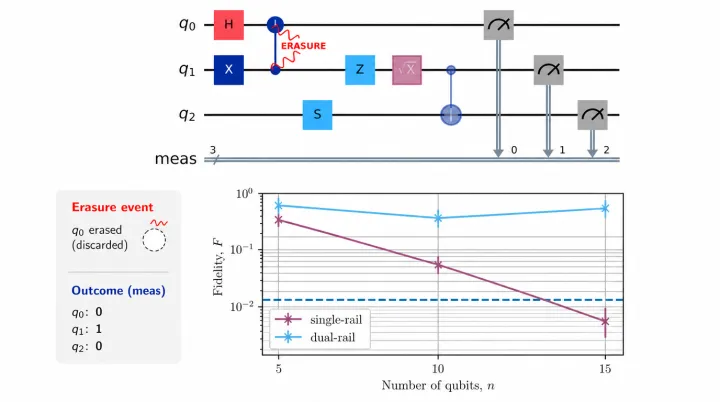
The sharper idea is not simulation alone. Erasure noise is less like static than a missing-pixel alert: in quantum information theory, an erasure channel flags that information has been lost. Rather than treating every fault as an unknown flip, researchers can model detectable loss; dual-rail encoding stores logical information across two physical modes, while post-selection rejects runs that announce failure. Small change. The workflow can expose the trade between acceptance rate and logical error rate before scarce machine time is spent.
That openness could matter more than the simulator's name suggests. By placing erasure noise and post-selection beside ordinary Qiskit circuit design, Erado offers a shared test bed for quantum error correction studies and decoder assumptions. The code acts like a diagnostic console for fault-tolerant quantum computing; the real mechanism is syndrome information, while the metaphor describes its flashing warnings. Watch the feedback loop. As hardware exposes detectable loss rather than only opaque errors, simulation may turn post-selection from a theoretical filter into a design choice that changes which experiments deserve a run.
Loading...

