When Wet and Dry Grains Collide
2026-09-24
A wet crust can deceive. Beneath its bonded surface, a dry granular layer may stay loose, so an eroding flow meets not one material but a shifting boundary where capillary bridges, grain friction, and pore-water pressure compete for control. Dry grains yield first. The surface then loses support from below, and what looked like a firm shell may break into transportable particles once seepage rearranges the contacts.
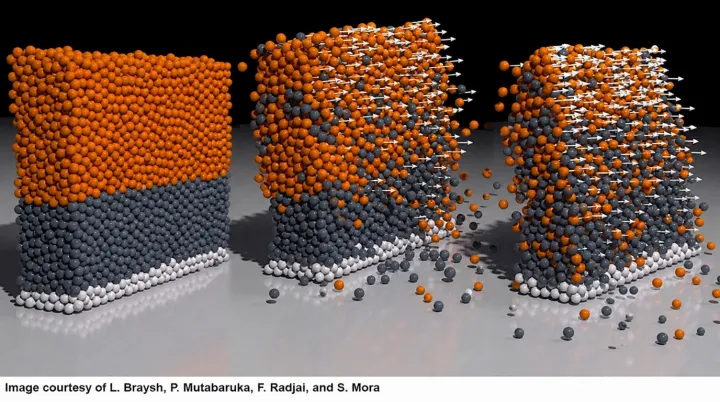
Interfaces carry the harder truth. A useful erosion model must resolve how shear stress is partitioned across contacts while infiltration changes matric suction and effective stress; otherwise, it mistakes a cohesive skin for bulk resistance and misses the instant at which grains begin to mobilize. That error compounds fast. In a wet layer, liquid bridges create cohesion; in a dry layer, frictional contacts govern resistance. As water penetrates, capillary cohesion can weaken, yet local pore pressure can also alter contact forces, producing slip, collapse, or armoring according to layer thickness, packing density, and flow intensity.
Prediction should start with failure. Models that couple discrete grain motion to fluid flow can track this handoff, but only if their parameters represent both saturated and unsaturated states rather than averaging away the boundary. The payoff is practical. Better estimates of sediment release can guide channel protection, slope design, and material handling before a thin wet film turns a stable bed into a moving front. Such models do not merely describe loss; they expose which layer sets the pace, and where a modest change in moisture can reverse it. At the edge, the grains keep their counsel.
Loading...

