AI Beats Human Physics Calculations
2026-09-30
Not a parlor trick. AI has surpassed human-designed methods at a task theoretical physicists treat as a bottleneck: generating intricate, precise predictions for what experiments should measure. The gain is concrete, because a calculation that misses a small quantum correction can send an instrument team hunting a signal that was never present.
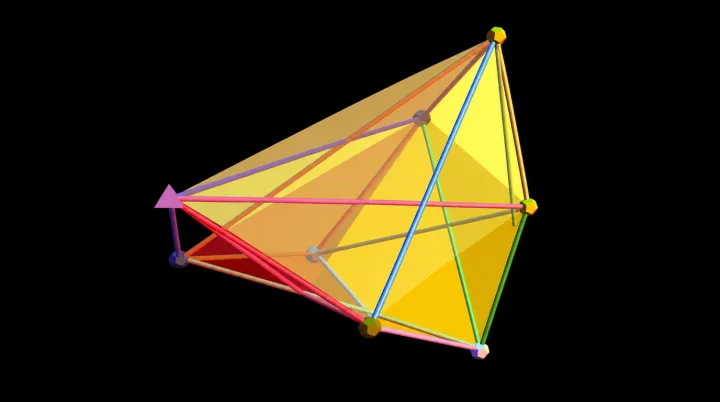
The machinery is the story. In perturbative quantum field theory, a prediction can require huge families of Feynman integrals, cancellations among terms, and renormalization before it can meet experimental precision. Here, the AI behaves like a compiler: it sorts and rewrites the algebraic workload so that the relevant contribution emerges without the usual brute-force search. It was slow. Human experts had to choose reductions, check identities, and chase errors through expressions that could swell beyond any intuitive sketch. That is computation with consequences.
That changes the wager. Better theoretical predictions do not replace a detector; they tell experimental teams which deviations deserve attention and which are bookkeeping noise. If the approach transfers across particle processes, theorists could test ideas that have sat beyond practical calculation, while experiments receive sharper targets before scarce machine time is spent. The near-term prize is not a machine that replaces judgment; it is a machine that makes difficult judgment arrive with better numbers. The code is not discovering nature by itself. It is changing how fast physics can ask nature a question.
Loading...

