Five Routes Through Mouse Serotonin
2026-10-02
The mouse serotonin system has stopped looking like a single control knob. A new whole-brain projectome, reported as the first in a vertebrate, sorts serotonin-producing neurons in mice into five groups by their axonal projection patterns. That is a sharper claim. It argues that brain-wide chemical signaling is organized by distinct routes, rather than one uniform stream.
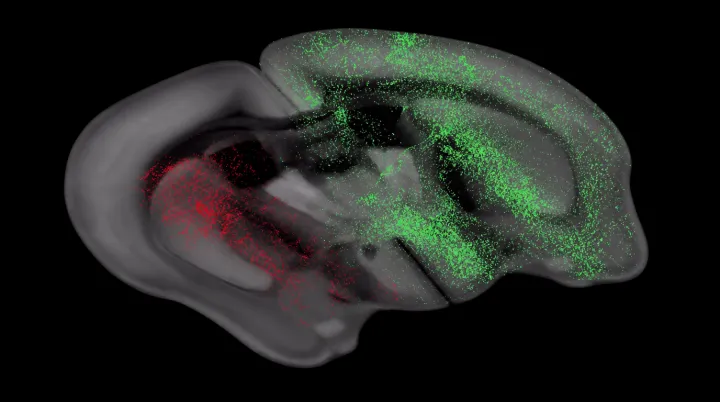
That simplification was costly. Rather than count cells by location alone, the study frames neuronal identity through where fibers travel across the brain. In serotonin neurotransmission, the projectome behaves less like a broadcast tower than a routing table: five neuron groups send axonal projections along different brain-wide paths. The analogy has limits. These are cells, and their axonal projection patterns are anatomical wiring, not software commands.
The prize is clarity. By separating five groups, the map gives experiments a cleaner target: researchers can ask how one projection-defined population affects behavior, physiology, or disease models without treating serotonin as a single actor. Maps do not prove function. Yet that shift matters because drugs and disease models often confront a system reduced to one chemical label. If comparable projectomes can be built across vertebrate brains, neural circuits may become legible as linked routes whose effects can be tested one path at a time.
Loading...

