IsaacTeleop Turns Motion Into Action
2026-10-04
Mimicry is weak. A tracked hand closes while a controller tilts, and IsaacTeleop treats those moments as inputs to a graph-based retargeting engine rather than as motions a robot must copy joint for joint. NumPy does arithmetic. The result is commandable intent, not mechanical impersonation.
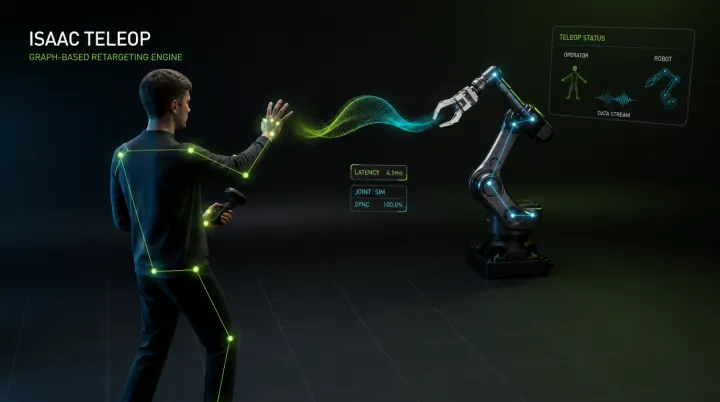
The graph is the point. Rather than bind every input directly to every actuator, the tutorial frames retargeting as connected mappings between source poses, intermediate frames, and target joints; a change in one node can be evaluated against constraints elsewhere in the kinematic chain. Less guesswork follows. The method uses rigid-body kinematics, coordinate transformations, and joint limits to keep commands meaningful when hand geometry and robot morphology do not match. This matters because a controller carries sparse intent while a hand tracker carries dense spatial measurements, and neither is a robot joint command until the mapping supplies a coordinate frame and permitted range.
Scale is the prize. The graph behaves like a packet router, yet its governing science is rigid-body kinematics: it routes motion goals through defined relationships instead of spraying raw tracker values at hardware. That trade is cleaner. Developers can swap tracking sources, revise mappings, and test command logic in NumPy before a robot acts. Such separation could turn teleoperation from a replica game into a programmable motion interface, where one gesture drives many bodies without erasing their mechanical differences.
Loading...

