Faster Magnetic Randomness
2026-10-06
A flickering tunnel junction matters. In simulations, ferrimagnetic and non-collinear antiferromagnetic tunnel junctions produce random outputs at rates that could outrun conventional magnetic designs, because their coupled magnetic sublattices can reverse through different pathways rather than waiting for one uniform magnetic moment to yield. The switch becomes restless.
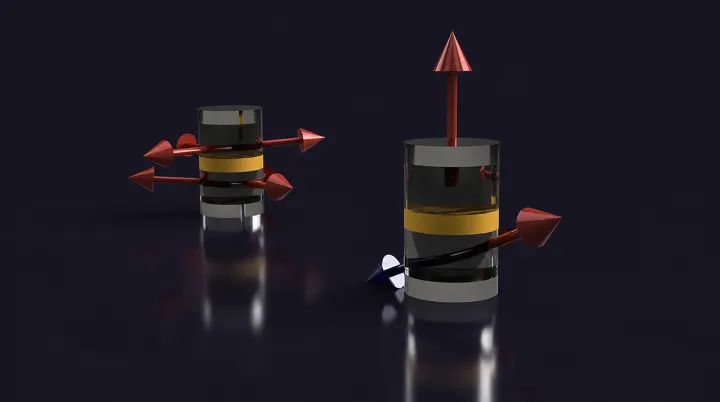
That speed changes the wager. Random-number generators do not need a perfect stream of orderly bits; they need entropy that can be sampled quickly, shaped for a circuit, and produced without a bulky external noise source. Stochastic magnetization switching, the physical mechanism at issue, behaves like a background process in a processor: it keeps running, then a read circuit captures a useful event. The analogy is digital; the physics is thermal and quantum fluctuation within coupled spin systems.
The advantage is not merely haste. Ferrimagnetic junctions contain oppositely aligned magnetic sublattices with unequal moments, while non-collinear antiferromagnetic junctions use spins that do not point along one shared axis; both arrangements can open switching channels unavailable to a simple ferromagnet. Tunability is the prize. By altering exchange coupling, magnetic anisotropy, or electrical bias in the simulated devices, designers may tune switching statistics and output rates for security hardware, probabilistic computing, or low-power sensing. If fabricated stacks retain those statistics amid defects and circuit noise, randomness becomes an on-chip material property.
Loading...

