Menopause Is Not an Ovarian Shutdown
2026-10-14
Menopause is not ovarian retirement. A study of ovaries from 28 women, conducted by scientists at Northwestern University and the Buck Institute for Research on Aging, challenges the familiar assumption that these organs become defunct after reproductive life ends. Activity persists for decades. The distinction matters: an end to ovulation is not necessarily an end to biological work.
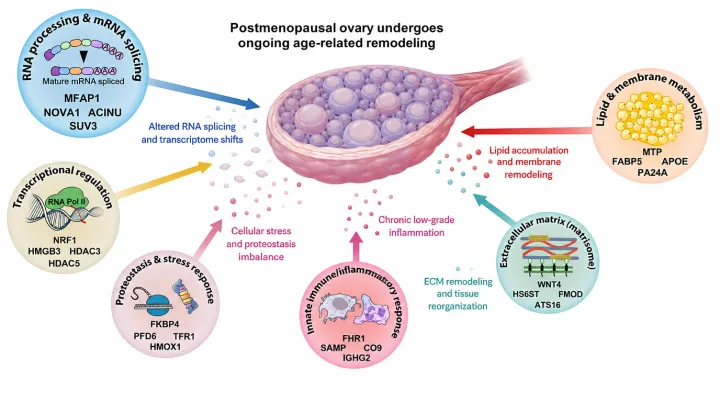
The shutdown metaphor obscures biology. Ovarian follicles, the structures that house developing eggs, underpin the reproductive cycle; their depletion helps explain why menopause ends regular ovulation, but it does not mean every remaining cell becomes inactive. Function has several meanings. Steroidogenesis, the biochemical production of steroid hormones, is another dimension of ovarian biology, distinct from releasing an egg and supporting conception. Those distinctions frame the finding without supplying results the available account does not report: precisely which activities persisted, how strongly they persisted, and whether they differed among the women studied.
The finding deserves restraint. A sample of 28 women can challenge an assumption, but the information provided does not establish how residual ovarian activity affects symptoms, disease risk, or responses to treatment across the wider population. Fertility is another question. Continued biological activity should not be mistaken for renewed egg production, restored fertility, or evidence that existing medical care should change. Nor does activity alone reveal whether the tissue's effects are beneficial, harmful, or clinically negligible; that requires measurements tied to health outcomes, not simply evidence that something remains underway. The curtain has fallen on reproduction; the machinery behind it has not necessarily stopped.
Loading...

