Dolphin Precision Has a Ceiling
2026-10-14
Precision has its limits. Jitter-delay tests show that dolphins combine information when judging distance through echolocation, yet the benefit reaches a threshold rather than increasing without restraint. More is not infinite. The finding challenges a tempting assumption about these animals: that an exceptionally sensitive acoustic system can keep sharpening its estimate simply by receiving additional evidence.
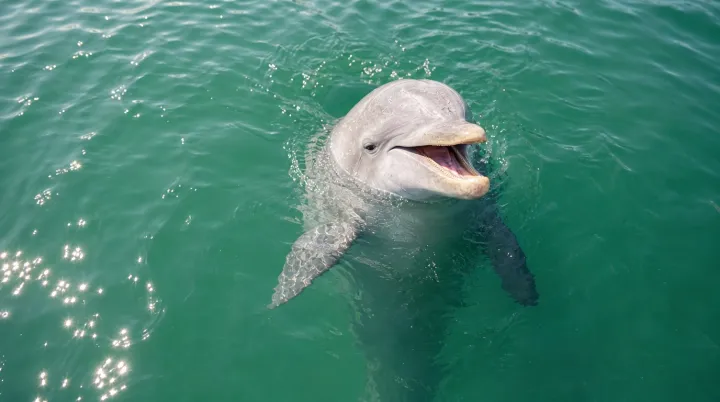
Noise becomes the examiner. In jitter-delay experiments, variation in echo timing tests how an animal handles uncertainty in the returning signals that carry distance information. Timing supplies the ruler. Because sound must travel to a target and back, echo delay corresponds to range through the relationship between travel time and sound speed. Integration offers an advantage. Combining information can reduce uncertainty, but the reported threshold indicates that this benefit does not continue indefinitely. The distinction matters scientifically. Range discrimination measures whether distances can be distinguished; it does not, by itself, identify the neural mechanism responsible.
The ceiling deserves restraint. A limit on improvement supports a bounded account of information integration, not a claim that dolphins suddenly stop hearing echoes or lose their ability to judge distance. Interpretation requires more evidence. Without numerical thresholds and experimental details, the result cannot establish a universal cutoff across dolphins, tasks, or acoustic conditions. Intelligence need not mean limitlessness. Here, the interesting result is the combination of useful evidence with a measurable boundary on its benefit, rather than either flawless performance or simple failure. The echo still returns. What remains finite is the precision extracted from its arrival.
Loading...

