Earth's Core May Be Leaking
2026-10-18
Earth's core looks less sealed than textbooks might suggest: chemical fingerprints in volcanic rocks point to material crossing from the planet's metallic interior into its rocky mantle. The boundary may leak. If that interpretation holds, eruptions can deliver traces of a reservoir that has remained largely inaccessible since Earth's formation.
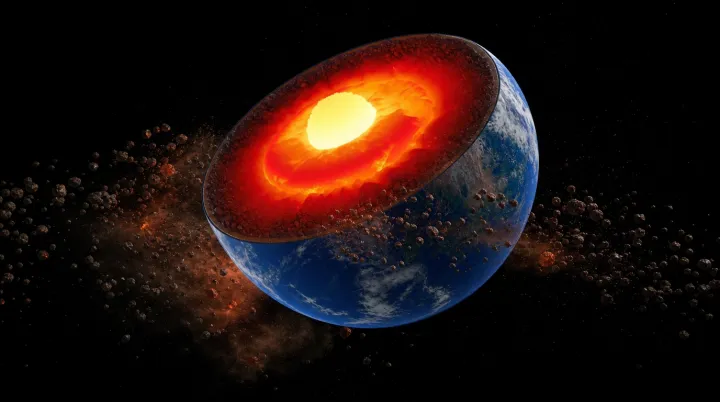
The strongest evidence is chemical. In Hawaiian volcanic rocks, researchers have identified elevated proportions of ruthenium-100, an isotope whose distribution can help distinguish material associated with the core from material in the mantle. The distinction matters enormously. Because ruthenium preferentially entered metal as Earth differentiated, the measured signature supports an exchange across the core-mantle boundary, followed by transport toward the surface through mantle plumes. Gold enters the discussion. The core also contains a vast store of that metal, but a ruthenium signal does not establish how much gold escapes or make volcanic deposits an accessible source of core treasure.
Helium complicates the story. High helium-3 ratios in some volcanic rocks point to ancient reservoirs, although whether the core supplies that helium remains debated because the mantle can also preserve primordial material. These are distinct clues. Neither helium nor ruthenium amounts to direct sampling of the core; both require models of isotope partitioning, mantle mixing and transport to explain what reaches the surface. Earth's oldest cargo survives. Beneath an apparently settled crust, the planet may still be passing fragments of its beginnings upward, leaving its birth record in cooling stone.
Loading...

