Brain Monitoring Without the Tether
2026-10-21
Freedom changes the experiment. Wearable brain monitors promise something more useful than miniaturization alone: a way to study neural activity while laboratory animals move without a tether, rather than requiring their behavior to accommodate the recording equipment. The scientific prize is not merely a smaller instrument, but a less constrained subject.
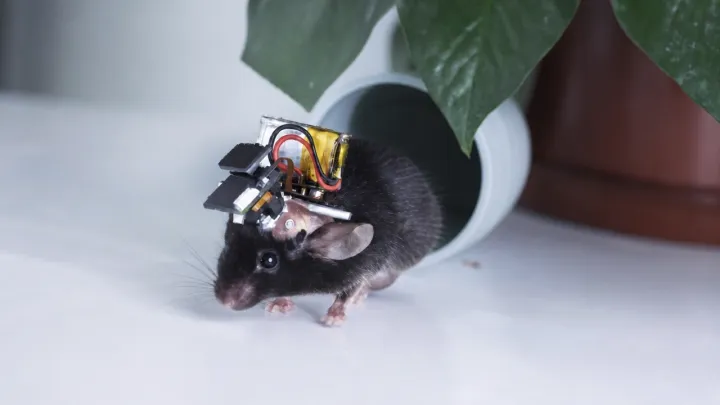
Coverage is not completeness. Observing thousands of individual neurons across the cerebral cortex can help researchers examine how activity in separate regions relates to movement, sensation, and decisions, although a broad view does not necessarily reach deep brain structures. The distinction matters enormously. In fluorescence microscopy, indicators emit light that instruments detect; calcium imaging uses changes in intracellular calcium as an indirect measure of neuronal activity, rather than recording every electrical impulse itself. Signals require careful interpretation. A brightening cell offers evidence about its activity, not an unfiltered transcript of its messages, and movement can complicate the measurement.
Behavior deserves equal billing. An untethered animal can turn, explore, and interact with its surroundings, giving researchers opportunities to compare neural recordings with actions that restrictive equipment might alter or prevent. That freedom carries costs. Instrument weight, recording duration, image quality, and reliable identification of individual cells all affect whether a wearable system produces useful evidence rather than merely impressive footage. Smaller is not enough. The stronger experiment must preserve both the animal's behavior and the integrity of the measurement; otherwise, the apparatus disappears from the photograph while remaining an unseen participant in the result.
Loading...

